

The first dip
Snippets from Bangkok, Singapore, and a few islands in the Philippines

In December 2024, I began traveling around the world with my partner, Josh. I'm sharing posts along the way to document the journey, and explore the many learnings and feels that travel brings.
The nurse ushered Josh and I into a small, white room with a narrow bed, and pointed for me to lie down. She flitted over to the far corner, flicking off overhead lights, and pulled a curtain across the bed, shading my eyes from the single light she left on. A heavy, terry cloth blanket fell over me before she shuffled out of the dim room. Hidden behind the thin sheet of fabric, a few tears escaped my eyes. It was the first time since I’d gotten sick two weeks before that I felt truly comforted, at ease in the cocoon of private healthcare.
Less than an hour before, we’d walked into Bangkok Hospital and were swiftly attended to by a concierge of sorts. Dressed in a grey pencil skirt and matching blazer, the woman looked up at me expectantly, eager to help. She scanned my passport and tapped away on an intake screen before rerouting us back outside. We boarded a shuttle, a gleaming golf cart with brown leather seats, that drove us all of thirty seconds to the neighbouring building. Another concierge greeted us with a subtle bow, a common custom that was quickly becoming familiar after three days in Thailand. Following a sign for International Medical Services, we took an escalator upstairs and stepped into a waiting room through a wide, glass door. A nurse in a crisp white uniform and matching cap stood behind a desk. I showed her the note on my phone where I’d documented my symptoms. “Oh...” She said, hurrying to take a photo of my screen before gesturing for us to sit down.
The room was long and white, with a few sets of upholstered furniture sitting around unused. Josh and I perched on a cushioned bench and exchanged a glance, perplexed by the experience so far. All the employees, even the golf cart driver with his polished black sneakers, seemed to mirror the impossible cleanliness of the air, the pristine placement of every object. On our way upstairs, we’d passed a couple of nurses posing for headshots. Two women in pressed, pale lilac uniforms smiled into the camera. Their pale skin was bright and smooth; their eyes made bolder by dark liner. Old fashioned nursing caps fanned over their hair, which was pulled back neatly without a strand out of place. They looked like Barbies masquerading as medical professionals. Reporting for duty in a world where injury and disease played out like a doll’s; clean and contained, as shiny as plastic.
After a ridiculously short wait, we were beckoned into the doctor’s office. An examination bed was set up at one end, with a desk and chairs arranged at the other. An unnatural stretch of dead space hung in the middle, echoing the under furnished feel of the waiting room. The doctor greeted us from behind a mask with a bow of her head. She began asking questions, writing things down on a clean sheet of loose paper. But after a couple of minutes, her phone lit up with an incoming call, “I’m so sorry, I have to take this.” She remained facing us, listening intently and replying “kha” every few seconds. Until then, I’d only understood “kha” as part of the gendered phrase for females to say thank you in Thai1. Now, I saw it was a widely applicable form of conversational encouragement (and often pronounced long and slow like “khaaaaa”). In the weeks to come, Josh and I would find ourselves using it like a Joker card, capable of communicating anything and everything to each other with only subtle tweaks in tone.
The phone call continued, and sitting directly across from the doctor, I struggled to focus my gaze. My eyes found her sparkly Chanel earrings, her cheekbones muted with pale powder. Her shoes poked out from beneath the desk; navy stilettos with bedazzled brooches fitted onto pointed toes. The doctor suddenly looked up, removing her mask to mouth, “I’m sorry,” with an exaggerated movement of her lips. The act was almost goofy, a contrast to her formal appearance. She scribbled something on the paper and turned it around for us to read; I’m talking to the surgeon.
When the appointment was finally over, I was sent for bloodwork despite the doctor’s suspicion (and my own) that I had the flu. After a slow recovery from food poisoning the week before, Josh and I had both come down with fevers and a myriad of other flu-like symptoms. By the time we arrived in Bangkok, Josh was on the mend, but I was only just descending into the depths of aches and chills, a sore throat and headache. And then my stomach turmoil returned. That morning, I’d woken up with the blind faith that something had to give.
My bloodwork came back in thirty minutes, and everything, even my electrolyte levels, were normal. There was no foreign bacteria swimming through my veins, so the doctor prescribed an anti-viral medication. I had never heard of such a thing but nodded along in agreement, too fatigued by my prolonged lack of appetite to ponder what other perks private healthcare was dolling out.
“Now, do you think you can stomach the pills? If not, I’d recommend that we admit you.” The doctor said.
“No, no, I’m sure I’ll be fine.” Lying in the narrow hospital bed, I was suddenly spooked by this level of professional caretaking. I could only imagine the high-quality continuum of care that awaited me, the decadent meals I would be served three times a day (plus snacks, surely). But imagining the bill that would also accompany such an experience was enough to send me packing.
Less than ten minutes later, we were outside waiting for a taxi. After taking my payment, the pharmacist had emerged in a matter of seconds. In addition to anti-viral pills, the doctor prescribed pain killers, electrolyte powder, something to reduce phlegm, and something else for bouts of digestive unrest. Josh and I sat in silence while the pharmacist read the instructions off each of the freshly printed labels. She handed over the bundle of crisp, resealable plastic bags, all perfectly sized for what they contained. I was too bamboozled by the whole experience to protest the items I could have easily bought at 7-11 for less.
Before we stood up to leave, Josh turned to me with a reassuring smile, “You look better already.” I wanted to deny it, to validate spending the bulk of the day transiting to and from the hospital. But the truth was, I did feel lighter, untethered from the cloud of doom that had followed us since that day on a tiny island in the Philippines, when we both fell victim to the poisonous aftermath of a simple lunch.

We had planned to spend around three weeks in the Philippines. We spent the first couple of days in Metro Manila, a vibrant and crowded city. On the ride in from the airport, cars and motorbikes swerved around us, squeezing by one another, content to constantly cut each other off. I looked up to find a truck driver shaving his neck with a dry razor. He inched along in the web of traffic, shirtless and with his eyes fixed on the giant side mirror. Inside our taxi, I became keenly aware of how thin the car doors were, separated from the chaotic underpass by only a delicate shell.
Later that night, we came across a food market down the street from our hostel. We grabbed two beers and a plate of pork skewers, avoiding the intestines squiggled onto their own wooden sticks. A band came on stage and belted out three Alanis Morisette songs in a row. It was our first taste of the Philippines and foreshadowed much of the week ahead: heavy on pork and riddled with an uncanny number of talented singers.
Over breakfast the next morning, we made friends with the two young men next to us. Neither of them looked a day over eighteen but proceeded to tell us about their careers in the Filipino police force. Frank, who was more comfortable with English, carried most of the conversation. He joked and laughed, introducing his colleague as half-Korean and therefore, involved with all matters of “international affairs”. We talked about the kind of investigations they were assigned to, and he proceeded to tell us about recent kidnapping incidents in the Philippines.
“But you don’t have to worry, no one will kidnap you, you’re Canadian!” He smiled and then mentioned an American YouTuber recently kidnapped on an island that was a rare destination for foreigners.
“What happened to him?” I asked.
“He is presumed dead.”
I changed the subject for my own sake, “Do you know a store that I could break 1000 pesos at?”
“Oh, I can give you change, no problem,” Frank lifted a black bag from the floor and opened a structured lid to reveal stacks of freshly pressed bills. “And take these as a souvenir, they just stopped making them.” I tried to protest as he handed me a few extra twenty-pesos after exchanging my thousand for hundreds. “Take it! It’s worth nothing.” He insisted.
“Why do you have so much money?” Josh laughed, peering into the bag.
“There’s never any cash in Manila, so I bring it with me,” Frank said, exuding the satisfaction of a young man with big responsibilities. He paused to answer a call from his boss.
“Are you guys are working today?” Josh asked after he hung up the phone.
“No, no. My boss was just calling to wish me a happy Lunar New Year.”
After traveling to New Zealand and Australia during Christmas and summer holidays, Josh and I had entered the Asian continent right on time for Lunar New Year. Before flying to Manila, we stopped in Singapore for three days. We walked around busy markets and ate at hawker centres three times a day, open-air markets housing hundreds of vendors selling quick and delicious meals. We devoured juicy soup dumplings and congee with Peking duck for breakfast, spicy crab and chana dal for lunch, and a platter of chicken and beef skewers for dinner. The atmosphere was as mesmerizing as all the food options. Neon colours lit up the signage on most stalls. Cooks worked in the closest of quarters, spilling out into the seating areas to chop up a giant basket of green onions or soap up dirty dishes in a tall plastic basin.
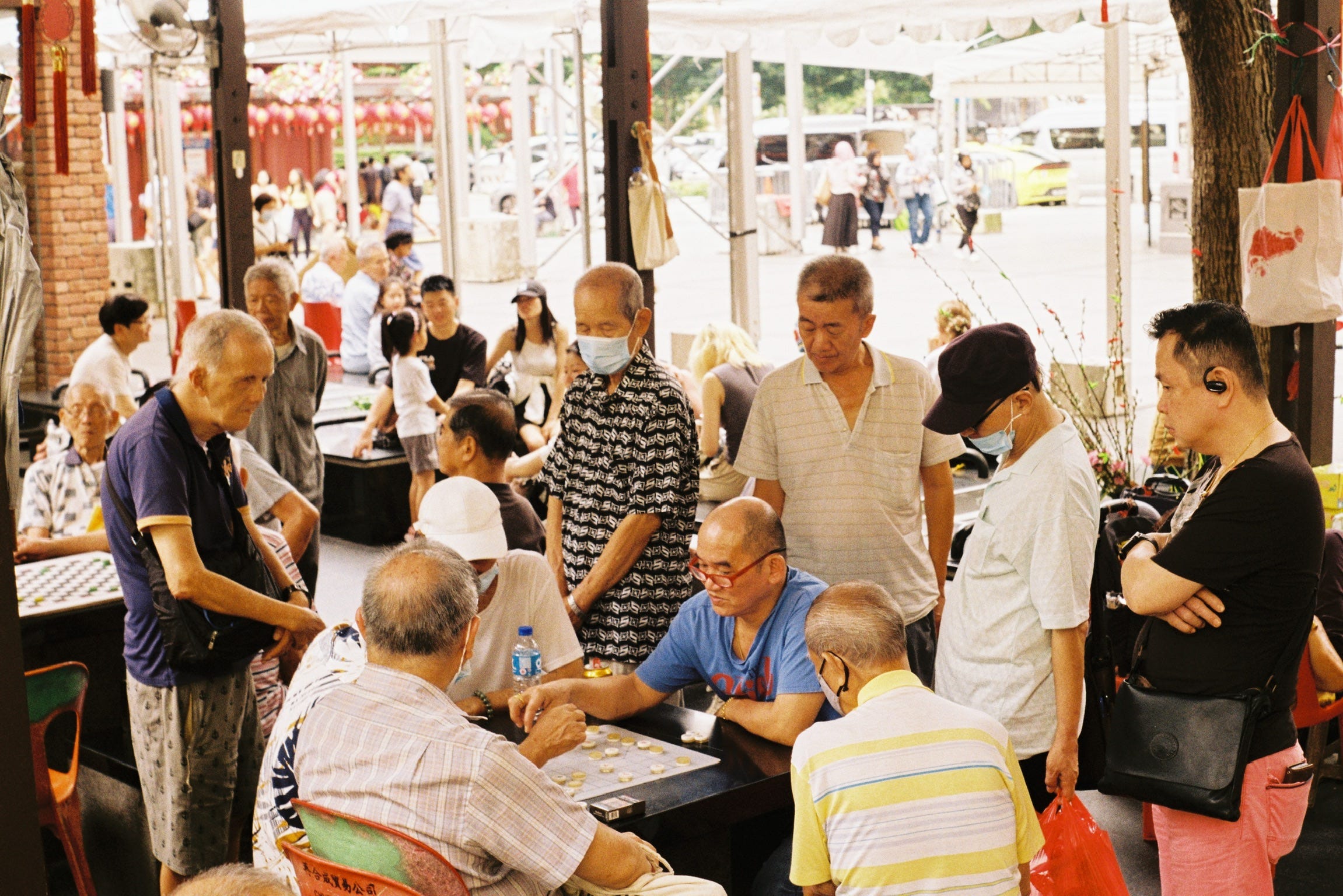
We stayed in Chinatown, where Lunar New Year decorations were hung up in the streets and shops were stocked with walls of red and gold banners wrapped in clear plastic. On our last night, I rushed Josh over to the famous Gardens by the Bay. Every evening, a music and light show dances up and down the ‘supertrees’-- giant towers covered in foliage, with webs of metal branches in the shape of a funnel sitting on top. They look nothing like trees, but I was inclined to witness what futuristic entertainment Singapore had dreamed up. We arrived right on time, but the show never started. In its place was a multi-sensory celebration for the New Year. Crowds gathered in front of huge screens that replaced live concert stages with pre-recorded performances. Amusement park rides were dotted around, and the Chinese zodiacs were blown up in scarily large, cartoon forms.
Back at the breakfast table, Frank was talking about is love of travel. “My boss understands,” He laughed, explaining that he was known to ask for more time to complete an investigation on the off chance he could explore whatever island he was sent to, and perhaps enjoy a couple days at the beach. He asked about our own plans and invited us to visit his home in Vigan City. Frank exuded the joyful generosity I’d learned about the night before in a YouTube video. In it, a Filipino professor characterizes the Philippines as, “A culture of sharing. A culture that would like to bring people together.” He connects the tendency to, “The philosophy of Kapwa. Kapwa means the other person is also yourself.” After making plans with Frank and his colleague to eat Korean barbecue together for dinner that night, we temporarily parted ways.


A day later, Josh and I flew to the island of Busuanga. The cityscape was replaced by the lush greenery of palm leaves and banana trees. A short, round man named Romeo greeted us at our hotel with a soft smile, “Hello, welcome ma’am, sir...” We’d quickly learn that locals addressed all foreigners as ma’am or sir. But both addresses were always spoken together, and often irrespective of if both a ‘ma’am’ and ‘sir’ were present, making the formal practice playfully ironic.
With no beaches close to town and a pier offering scenic boat rides to nearby attractions, we signed up for a couple of tours. Our first day trip was a popular one and that morning, it was a manic scene on the pier. The administrative powerhouses behind the tours scribbled down names and numbers on multiple sheets of paper for unclear reasons, and pointed for folks to gather at vague spots on the concrete. Sellers waving around water bottles, hats, pearl jewelry and waterproof phone cases repeatedly stalked the groups of tourists, eventually making a sale.
After about an hour in the hot sun, Josh and I were shuffled along the dock. The boats were all built the same; long, narrow hauls with tall reeds of bamboo grafted onto either side. A myriad of colours and obscure names like Rasputin attempted to differentiate them. We were squeezed onto an orange boat called Magic Five, the benches packed with 20 something other people. Relieved to finally leave the pier, we were content to be sardines but a few minutes later, Josh and I were ushered back onto the dock with another couple.
“The coast guard is here, he says there’s too many people on the boat. We wait for another boat, then you go back on the other boat at the first stop.” One of the guys running our tour said as he shepherded us back to the pier. Josh and I stood around with our companions, a man and woman from China we’d briefly met earlier on. After a few minutes, the man tapped Josh on the shoulder to offer us each an ice cream cone. He stood with a slight hunchback, shielded from the sun in a pair of black tights, a long sleeve shirt and water shoes. We thanked him, and Josh explained he couldn’t have milk, handing me a second dripping cone. I devoured the mysterious flavours I didn’t recognize while Josh asked him about his trip in the Philippines. He spoke hurriedly, his sentences sharp and direct, “We are here five days, scuba diving.”
Eventually, the tour guide returned after walking away with a cigarette in hand. When we finally set off on the water, Josh and his new friend were onto the subject of American politics.
“He’s a nasty man,” The man from China said of Trump, the salty spray of the waves showering his face. “But I would have voted for him.”
“You would have voted for him?” Josh laughed.
“Yeah, I hate the establishment.”
After arriving to the smaller island of Coron, we were escorted on shore through a maze of wooden planks connecting a string of double-parked boats. We joined the pilgrimage of tourists marching up steep stairs to reach a lagoon on the other side. The destination was far from disappointing despite the crowds; a majestic blue pool surrounded by tall volcanic towers. The rock face plunged down endlessly below the surface of the water, creating a series of sharp ledges leading to darkness. I was reminded of the feeling of swimming in a cenote in Mexico, imagining what lurks beneath a seemingly infinite portal into deep Earth.

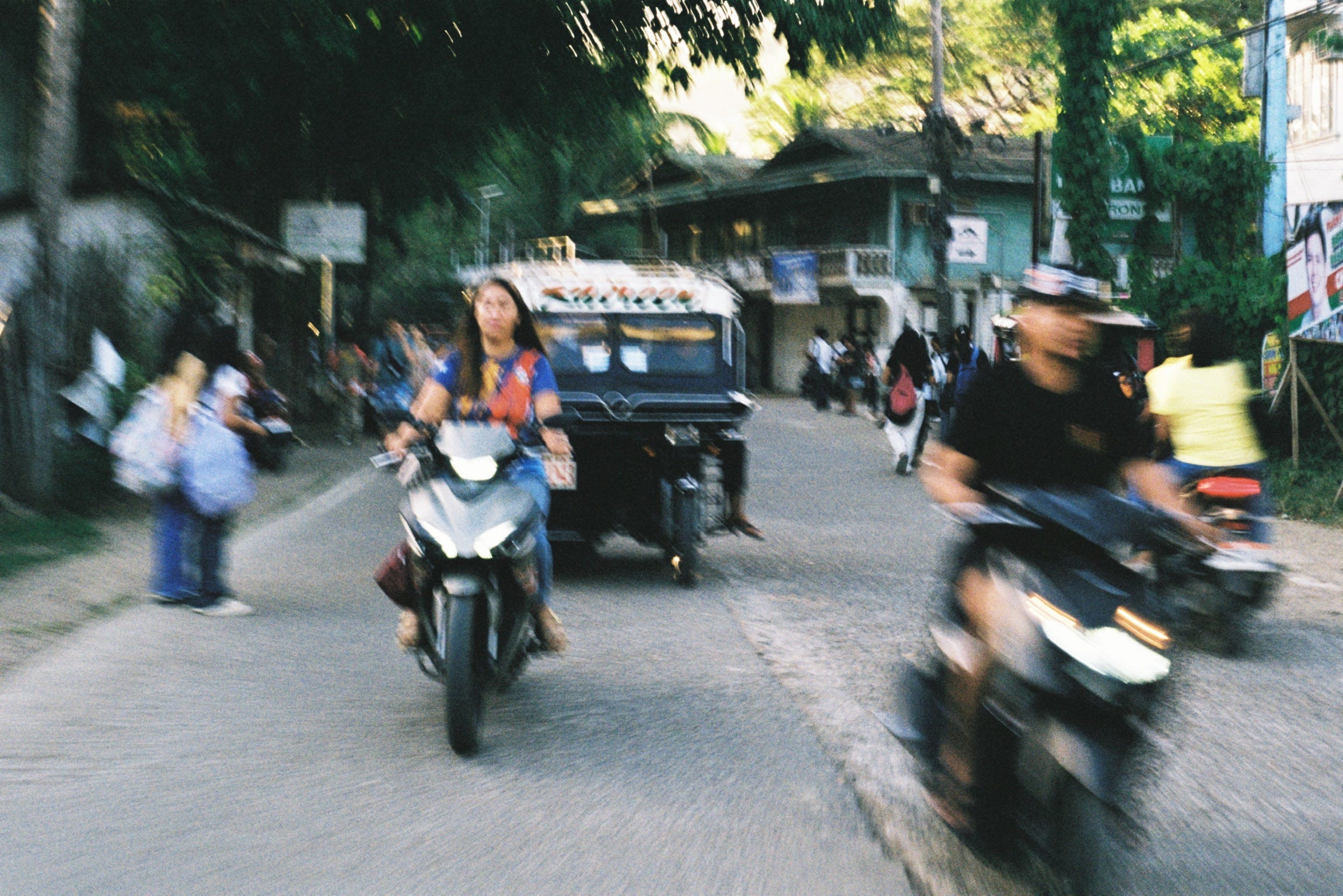
The day continued with more idyllic swims and passing views of tiny islands, mostly uninhabited by people, casting shadows over the sea. We made friends with a French Moroccan woman and an Italian man, colleagues at work and first-time travel partners. After the tour ended, we joined them on a ‘tricycle’ ride to the hot springs. Tricycles transported everything and everyone that didn’t fit on a single scooter. They were motorcycles with elaborate sidecars, both elements sheltered by a roof. They were rickety and loud, and extremely convenient.
After spending the day carted around like cattle on the water, we embraced our freedom in the steaming pools, re-integrated with a mix of locals and foreigners. A group of young people saddled up on the edge of the pool next to me and the French Moroccan woman. A British guy passed around a big bottle of whiskey to whomever would partake. My new friend and I instinctively cringed, familiar with this very specific tourist archetype. I left her side for a swim and returned to find an older man attempting to strike up a chat. She welcomed me back with another silent look, continuing to pretend she didn’t speak English. I joined in with the little French I could muster, and soon, the man moved along to the young women next to us. I felt momentarily ashamed of being anti-social, certain that he knew we spoke English. My new pal, ten years my senior, shrugged it off. “Please…” She said, alluding to the epidemic of white men haunting the streets of many Asian countries in ghostly pursuit of female company.
A couple days later, we embarked on another full day boat tour; a less crowded route that brought us snorkelling off the north coast of the island. I saw some of the most magical coral reef I’ve ever seen. A mesmerizing forest of alien shapes and colours; curvy layers pulsing in the current; sharp branches sticking out in protective protest. I floated along above the maze, following pairs of electric blue and yellow fish.
We landed on the pier again just before sunset. In the final moments of the boat ride, the noisy vibration of the motor became unbearable, turning my stomach in upsetting directions. My state only worsened on the drive back to our hotel. I floated through the courtyard in a daze, breezing past the sweet scene of Romeo and another employee walking arm in arm. In the safety of our dimly lit room, the perils of what I’d quickly decide was food poisoning overcame me and shortly afterwards, Josh, too. Before he started throwing up himself, I sent Josh to the hotel restaurant for supplies. Romeo arrived a few minutes later with a plate of warmed bread wrapped in tinfoil, two bottles of Coke and a mug of ginger tea. “Ma’am, sir?” He called from the other side of the door.
Forty-eight hours later, we were on a ferry to El Nido, on the neighbouring island of Palawan. The day before we were set to leave, I was convinced I couldn’t travel.
“Let’s just see how you feel later on,” Josh had said. After a fitful first night of sickness, I was emptied and exhausted. We survived on a liquid diet; I only managed a small nibble of bread before the whole stack was conquered by ants. As the day progressed, Josh’s innards dried up faster than mine, and he was gently suggesting that we still head to El Nido as planned. By late afternoon, I finally fell into a deep sleep. I woke up after sunset feeling suddenly stabilized. My thoughts began ticking away involuntarily, a to-do list forming in my head. A familiar pattern of anticipation reassured me that I was well enough to get out of bed, to stroll gingerly to the front desk and pay our tab in preparation for an early departure the following morning. I explained to the woman at reception that we might leave on the ferry, but it was still touch and go with our recovery. She nodded, picking up a box of electrolyte powder and handing me the last two packets, “A lot of guests get food poisoning...”
My alarm went off at four the next morning, and Josh and I began the strenuous task of packing our bags, filled with dread and determination. A tricycle driver was waiting for us when we emerged an hour later. The woman from the front desk hurried outside in a colourfully patterned night gown. She nodded to the driver that we were his to collect, and waved us off with the endearing look of a concerned mother.
A man at the port took our tickets and pointed to where two boats were docked side by side, “Green one.” He spoke gruffly, impatient in the morning light. I looked over to see that both vessels were white with subtle green accents. One was taller and wider; what I expected the ferry to look like. The other could have passed for a fishing boat. It sat low in the water with a small upper deck. We followed the trail of sleepy people and I realized with depressing certainty that we were boarding the smaller boat. Everyone had to crouch down to shuffle through the cabin door. I only had to glimpse the stuffy room of seats sandwiched together before I turned around, “I can’t sit in here.” I told Josh, breathless.
Back outside, the crew was piling all the luggage on one side of the deck. In the limited space leftover, a narrow bench made of rounded metal bars was bolted in on the other side. Two short, plastic benches were placed at the back of the boat. Josh and I sat down on the metal bench, our flesh sinking through the wide gaps in-between bars. An unpleasant stream of hot air flooded my face, and I realized there was a massive air conditioning unit beside me, forcing the stuffy cabin air back outside. The engine ignited somewhere below, starting up a loud, angry drum that vibrated the metal floor beneath my feet. The temperature was beginning to rise, the cool dew of the night whisked away by the sun. My stomach churned with anticipation. The reality that none of these conditions would change for the next four hours hit me like a brick.
After three days in El Nido, our appetites were still nowhere to be seen. Forcing ourselves to eat was a chore and a challenge, our guts rejected the now sickening smell of whole fish roasting over charcoal, and grilled pork glazed in sweet sauce. Before we fell ill, we had booked our stay in a glamping tent outside of the main town. We were nestled among rice farms where water buffalo lingered around, surrounded by peace and quiet. Tiny stores selling snack foods and gasoline in glass bottles dotted the road to the beach. In a better state, it would have been my dream oasis. But I craved the conveniences of a city, the luxury of a private bathroom. We made the difficult decision to leave the Philippines, and got on the next flight to Bangkok.
On our last day in El Nido, we mustered the energy to take a motorbike to the beach. Josh had been fighting off a fever for a couple of nights, but he was determined to soak in the idyllic surroundings. We stopped at the only pharmacy-like store on our way, I was convinced new toothbrushes would finally rid us of our afflictions. The young girl in the shop looked at me with confusion at first, and then pointed to a nearly hidden container on a cluttered, dusty shelf. Three toothbrushes rattled around when she picked it up. They were all unwrapped. I shook my head and politely declined.
At the beach, we found a shady spot on the sand and laid down in defeat. Too fatigued to read, my eyes lingered on the horizon, watching the gentle slopes and curves of the islands that stretched across the water in the distance. Before heading home, we walked along to the end of the beach. A little girl, about four years old, jumped in our path. She bent her knees and raised her arms up to Josh in what I immediately recognized as a plea to be joyfully swung around. Josh was momentarily cured, whisking her into the air and spinning her around with delight. We carried on after a few minutes, waving goodbye and heading further on down the shore. More kids ran around, laughing at each other as they climbed along bamboo racks like monkey bars. A man was hunched over nearby, applying a fresh coat of red paint to a boat in its cradle, the same kind of long boat that had led us to our demise. His back was to me, and I stopped to take a photo of his faded t-shirt. Above a globe captioned “Planet Earth” read the words, “Finding my home outside.”
Thank you for reading!
I’m happy to report we both made a full recovery from the perils of illness after a long week in Bangkok. We hope to return to the Philippines again soon and lap up more of the shockingly beautiful scenery and wonderful people. <3
Being the pompous English speakers that we are, we only learn how to say hello and thank you in other languages. It’s not something I’m proud of… but when you’re moving through countries as quickly as we are I suppose I can give us a small break. The Thai expressions for thank you became a favourite of mine, so incase you were wondering, here’s Google AI’s summary and a note on how we pronounced it in practice (which was probably wrong, but based on how we heard it):
khàawp khun (ขอบคุณ): This is the basic, standard way to say "thank you".
khàawp khun khráp (ขอบคุณครับ): This is the polite way for men to say "thank you".
khàawp khun khâ (ขอบคุณค่ะ): This is the polite way for women to say "thank you".
We heard and pronounced khàawp khun as “kapun”, khráp as “kap”, and khâ as “khaaaaaaaaaaa” (the most satisfying word ever).
Wonderful yet again Kat! I am so glad you are feeling better🫶